SPINNING WOOL
in the Mouth of the Monster
Excerpt
CHAPTER ONE
The family consists of the people of the house; as these increase, they are divided into brotherhoods (vllazni), brotherhoods into kinship groups (gjini), kinship groups into clans (fis), clans into banners (flamur), and all together constitute one widespread family called a nation, which has one homeland, common blood, a common language, and common customs.
The Kanun of Lekë Dukagjini
"Hit by a bus," said the paramedic who wheeled the gurney into St. Margaret's emergency room in Manhattan, where I was on my first day of rotation in my fourth year of medical school. "Trauma to skull, shoulder, knee, ribs." Not necessarily life threatening, but requiring immediate evaluation. "Walked right out in front of it," tsked the attendant, shaking his head.
He hadn't mentioned eyes, but when the patient rolled his head, I could see the pool of blood where the far eye should have been. The good eye passed over the paramedic and the intake nurses who were already checking his IV and his pulse, then fastened on me. His fingers fastened, too, with unexpected strength, on the sleeve of my exam coat, enough to bend me down to him. "Miss," he rasped, "my brother, his wife, you must find them, in the Bronx, they will tell you."
No one else seemed to be paying attention to his words. "Did anyone call them?" I looked up to ask.
"Call who?" The paramedic made a notation on his clipboard, scanned my name tag and added, "Miss—Dr.—Pelham".
"His family, the ones he's asking for."
The pen raised from the clipboard. "You understand what he's saying?"
"Of course."
"That's not English he's speaking. I don't know what it is."
* * *
They gave him to me. He only spoke Albanian, and Dr. Phelps, the attending physician, seemed to think I could. The two nurses came with us to the curtained cubicle, plus the triage nurse to record answers on her intake form while I did the interview and exam. I got his name first, Mark Vata, and the name and address of the relatives he lived with in the Bronx, another borough of New York City. I couldn't seem to convey to him the concept of insurance, but he was clear that his relatives would take care of whatever he needed. Dr. Phelps stood supervising, hands clasped behind his back.
The man's body was an entire seminar in orthopedics. I worked from the head down, the nurses working ahead of me to clear away clothes and blood obscuring the injuries. The skull wound didn't look serious, though the CAT scan might reveal fracturing. His shoulder was a scramble of dislocated and broken bone. The knee was as bad, patella torqued to Timbuktu, the long bones above and below the joint well and truly fractured. I sent a nurse for braces to immobilize both joints.
"Hit by a bus?" I asked the man, aware on some level that I'd cobbled "bus" from words for "big" and either "wagon" or "car," begrudging this language that came to me in bits and pieces from some place I could neither understand nor control.
"Po," he replied, which I recognized as "yes" in Albanian. He was taking deep breaths through his nose; I could see that he was skilled at coping with pain. "From over here," he added, gesturing with his good arm towards the side with the trashed shoulder and knee. "Just . . . I did not see it coming." That made sense; the eye on that side, the one I'd noticed had been obscured by a pool of blood, was not there. Instead, he had a nasty scar that looked like a burn. "And, you know, also I do not hear in that ear." I'd noticed that, too; the ear canal had looked sealed by a similar burn. "And besides, there are so many cars and big cars in this city, everywhere, all the time." He waved his hand in front of his face. "I do not always understand where they will be coming from."
All his current injuries were consistent with being hit on his blind side and thrown back against something hard on the other side, including the cracked ribs posterior right. The police and the bus company would be glad to have that for their accident reports. What didn't fit were the older ones, the eye and the ear and a series of marks on his torso, marks I'd discovered while palpating for signs of internal injuries, small round scars descending to his thighs and even his scrotum. "We'll have to do a state form for that," pronounced Dr. Phelps from his station near the curtain. As if I wouldn't know, I thought, suddenly and inexplicably irritated at him for . . . for just being what he was.
"You are Albanian?" Mark Vata turned his head to ask me as the orderlies raised the sides of his bed to wheel him away for the CAT scan.
"No," I denied, too quickly. "No, I'm not Albanian." Not in any way that counted. I was American, and I was going to be an orthopedic surgeon.
* * *
"I hear you've got a live one, Nancy." Greg Hunter burst into the cubicle where I was taking a moment to breathe, just to breathe. He was rubbing his hands together briskly, his painfully clean surgeon's hands, the blunt strong hands that had anchored countless climbs for me at the rock gym.
"You're going to operate?"
He nodded emphatically. "You think anything could keep me from a rebuild of a knee and a shoulder joint?"
I didn't. I only wished I were on surgical rotation so I could assist. "You just missed him. He's in CAT scan now. They should have an image for you to look at soon."
"I know. That's why I'm down here." He considered me, head cocked to one side, then moved in close, placing both hands on my waist, dipping his head for a kiss. "That and . . ."
I pushed him away. "We're working."
"That we are. Tonight?"
"I don't think so. I've got—"
"To wash your hair. Okay." And he was off, whistling on his way down the curtained corridor.
He was a whirlwind. The plan was that we would be whirlwinds together.
* * *
When Greg came back, he had the scan with him. He wasn't supposed to be able to intercept it, but of course he had. We looked at it together until the orderlies wheeled the patient back. It was clear from the scan that our hotshot orthopedic resident had his work cut out for him. He began to whistle again. I was silent, struck by what he wouldn't be working on, the long imbedded history of insult to bone, the healed and rehealed finger bones and reknit cracks in ribs.
After Greg had explained the upcoming operation to Vata through my guerrilla Albanian and left, I pulled a chair up to the patient's bedside and sat, the state form on a clipboard on my lap. There is never privacy in a hospital. Nurses swirled around us, prepping him for the operation. One in particular drew my attention; she had a kind of matter-of-fact empathy that was comforting. Her name tag, I noticed, said Ayo Mokumba; from her accent, she was probably an immigrant from a troubled African country.
I leaned in towards Mark Vata and asked as delicately as I could, "Are you afraid of anyone you live with?"
He understood the concept of fear, but not the concept of his family hurting him. "My brother and my sister-in-law, they are only kind to me. They help me to come here, to America."
"How long have you been here?"
"In America, New York? Three days."
That left anyone in this country free from suspicion of abuse. "Where did you come from?"
"Albania!" Of course. "Well, Kosovë, but I got away through Albania, then came here."
My geography of this region was weak, though my parents came from there. "How did you get away?" I asked, not entirely for the form.
"Over the mountains!" Of course. "That is all that separates Kosovë on the north from Albania on the south." The blankness I tried to hide, that came from more than difficulties of translation, must have shown. Patiently, he tried to explain. "You must know that all the people, well almost all the people, in Kosovë, the 'Yugoslav province' of Kosovë, are Albanians by race. Long ago, after the big war, when they make the new country Yugoslavia, they divide Albanians in Kosovë from Albanians in Albania along the high points of the land. Into Yugoslavia, like cats and dogs tied together into a flour sack for drowning, they put Albanians, Croatians, Bosnians, Serbs. The Serbs who follow the bad leader Milosevic have tried to be the master. When others want to break away, they try to destroy them. The Croatians and Bosnians have broken free after great trouble. Now Milosevic's Serbs are trying to kill or drive away the Albanian Kosovars so they can keep the land without the people."
I had understood the gist of it. He sank back onto the hospital bed, his body almost concave from spent effort. There was only one more thing I had to ask him. Leaning towards him again, I said cautiously, "You have many wounds that are not from today."
His mouth closed into a straight line.
I tried other words, using my hands to help. "There are bad places on your body that we can see. Your eye, your ear, the marks on your stomach. With the machine we also see bones that have broken, fingers and ribs."
At last he released a sigh and admitted in a flat tone, "Milosevic's followers did not want us there, in what they claimed was their land. They tried to drive us out, they tried to squeeze us unto death. I was one of the ones who complained, who gave a voice to our complaint. Every time I would say something, or encourage other people to resist, or even if I did not, they would take me in the dark of night, and do what they could to 'discourage' me." My heart twisted as his voice did on the word "discourage." "At last, I had to leave or let them kill me. I left, walking over the mountains . . . to Albania . . . to the homeland . . ." His voice trailed off as the drugs overcame him.
I was still sitting, my hand over his, when the orderlies came to take him to the operating room.
* * *
I went to the climbing gym at the end of my shift. It was a good place to feel things through. The climbing faces weren't real rock, but when I allowed myself to imagine they were, they allowed me to feel, for a while, rooted in the concreteness of the earth. Since I didn't have a partner to anchor me tonight, I stuck to the bouldering wall. Very technical, but you wouldn't fall very far. Like the delicate arthroscopic work of trimming damaged cartilage from inside someone's knee, it made you focus so completely that everything else dropped away.
Tonight the magic didn't work. The very wall I was scaling felt unstable, as if it were being undermined even while I climbed by an unseen web of cracks, as if any of my holds could shear off at any moment. Internal boundaries were splitting, too. Words I hadn't remembered I knew, for "rock", for "leg", for "heart", kept bubbling up through fissures in internal pavement I'd considered as solid as the sidewalk I strode to work on every morning.
That's not English he's speaking. I don't know what it is.
My fingers lost their grip on a stingy ledge and I slid, scraping, about eight feet, to land in a crouch on the floor. I started up again.
Are you Albanian? No.
Almost immediately, my foot twisted off a toehold to dump me five feet onto my backside.
I gathered my gym bag and went home.
* * *
Limping back into my apartment, just up from St. Margaret's at Amsterdam and 123rd, I ran into my roommate Liz going out.
"Oh, good," she said, handing me a letter. "I was just trying to figure out what to do with this." She stood at my elbow, expressive eyebrows raised, while I read the return address. She was aiming for a residency in child psychiatry herself and knew as well as I did how important a letter from a hospital's personnel department could be at this time in our fourth year. "I can't stay," she told me, "I've got evening shift at the Family Practice Clinic. Let me know." The door slammed after her, reverberating loudly through the stairwell outside.
I let my gym bag fall to the floor and walked slowly, envelope held before me, to the couch we'd gotten at IKEA when we'd all moved in four years ago, full of ambitions and dreams. Only one of the lamps we'd wired with a snakes' nest of extension cords was on now, its shade askew. The coffee table, the only flat surface in the shoebox-sized living room, was strewn with mail of various vintages, an open bottle of Tylenol, a half-empty bubble-pack of gum, a half-filled application form. The arms of the sofa and the one chair were draped with random articles of clothing that had not made it to closet or hamper. In the kitchenette, on the tiny table that seated two, lay a packet of bagels not resealed, a bag from Liz's takeout last night and a medical textbook held open by a hair dryer. In the sink, dishes waited to be washed. My roommates and I were always passing through to do something else somewhere else.
I sank slowly onto the couch. The envelope was heavy, which was a good sign. I took a breath and tore it open. The Board of Overseers of St. Margaret's Hospital in the Borough of Manhattan, City of New York, the cover letter informed me, was pleased to offer me a residency in orthopedic surgery. A wave of weakness washed over me. This was everything I'd been working towards, fighting for, hoping to achieve since I'd started premed at Columbia six years before.
My parents would be so pleased. I could stay in this apartment, which despite its size was a plum for Morningside Heights. Greg might even move in. I could keep going to the same rock gym. Learn to treat people I understood, active professionals who injured bones and worked hard to recover.
I sat on the couch with the letter draped like a dishrag across my palms.
It didn't, all of a sudden, seem to matter so much.
As if to mock me, the Albanian word for "doctor" bubbled up into my mind.
CHAPTER TWO
To create a brotherhood in a village means to agree that a household from a different Banner may come and settle in the village of another banner. . . . It is the responsibility of the new brotherhood to participate in the affairs of the village.
The Kanun of Lekë Dukagjini
I started dropping by Mark Vata's hospital room to visit him. We talked in Albanian, we talked of Albania, we talked of conditions in Kosovë, as it was called in Albanian instead of the Kosovo of the English and the Serbs. I met his brother and sister-in-law and talked to them sometimes in the colloquial American English that had surprised and relieved me when I'd first talked to them over the phone. In my apartment at night, curled over my laptop in the bed that filled my bedroom except for a spare foot around two edges, I began to google Albania and Kosovo.
I learned that Milosevic, the leader of the Serb-dominated Yugoslav government in Belgrade, had unilaterally rescinded long-standing autonomy for the mostly ethnically-Albanian province of Kosovo ten years ago, in 1989. Since then oppression had escalated until a resistance movement, the Kosovo Liberation Army, or KLA, had arisen. World opinion feared that ethnic cleansing would soon be unleashed in Kosovo as it had been in the since-escaped provinces of Croatia and Bosnia. The US and NATO had intervened with ultimatums to force Milosevic and the KLA to the negotiating table in Paris. Still, a steady stream of Kosovar Albanians were fleeing to neighboring states, especially the mother country of Albania.
I did not learn where my parents came from, why they had left, why they never spoke with me of Albania or in Albanian.
* * *
"You missed the reconstructions," said Greg the next night when he was shoehorned into my bed with me. The reason I had so little floor space was that I'd refused to have a bed smaller than a double. Still, with two in it, it was not exactly spacious.
"What reconstructions?"
"Shoulder, knee, on your refugee."
"Mark Vata?"
"It's not like you not to observe an operation like that."
"I was tired. I needed time to think."
"We're always tired. Think about what?"
I replied with a tidbit from a site I was scrolling through. "Did you know that over a hundred thousand Kosovar Albanians have fled from Kosovo into Albania over the past two years?" Almost to myself I added, "They need food, shelter, medical aid, volunteers."
He rolled over to place his elbows on either side of me. I felt the density of his presence and his will. "You know that if you decide to do this, you'll be doing it alone." Then thought was lost in lovemaking, hard and direct and breathtaking as a swift rappel down a clean cliff. When I surfaced it was to the thought, "Do what?"
* * *
I made a deal with the Vatas to exchange language lessons after Mark's discharge from the hospital. We would do some at the Vata's house and some at St. Margaret's when Mark came in for his physical therapy—keeping a sharp eye out, I cautioned him, for busses.
The first time I tried to follow the directions to their house, I took a couple of wrong turns and ended up hanging a U-turn in a cul-de-sac. Struck by a strong sense of deja vu, I came to a sudden stop facing a stone house that looked like an old carriage house split into apartments. Something about it seemed familiar, even as my grown body felt suddenly unfamiliar. I shook off the feeling and reoriented myself to my directions, but the image stayed with me, surfacing later attached somehow to the image of a man, a hearty man about the age I was now, with a dark and bristling mustache.
* * *
A few days later I called my parents at the home where I'd been brought up in Centreville, Long Island.
"Did we have a, a cousin, an uncle?" I asked my mother. "He might have lived in the Bronx when I was younger, in a—"
"No."
Are you Albanian? No.
"I was there today—"
"Where?"
"In the Bronx. There's a big Albanian-American community there, you know." I'd learned that from Mark Vata and his family.
I could hear my mother draw a long breath. "It has been too long since we've seen you. Do you think you could come out to visit this weekend?" Then she turned the phone over to my father.
"So," asked my mother, smiling up at me as she hooked her arm in mine to lead me into the house, "have you heard from St. Margaret's yet about your residency?"
"Not yet." My mother was concrete; something that had achieved manifestation in the physical world attained an almost irrevocable density. "I've been thinking about that."
My mother's grip loosened and she pulled back a bit, gesturing me towards the facing sofas in the living room. "Yes?"
I sat on one of the sofas while my father whisked my overnight bag upstairs; it was unthinkable, in this house, for a woman to carry her own suitcase. The living room arrangement had always seemed to me like a furniture showroom, matching sofas facing each other across a coffee table with an open fireplace on the wall end. My father's progress back to us was marked by increasing silence as he turned off the television in the study, then the radio in the kitchen.
My parents sat side by side now, facing me with perfect host and hostess expressions, my father tall and grey-eyed, my mother short and solid with perfectly coifed dark hair. The fact that they had chosen to settle me here, instead of in the kitchen around the family table, meant that they saw this as more of a formal interview than a family chat. The fact that my mother was not plying us with coffee and teacakes meant that the universe had spun off course.
There was a newspaper, folded for reading, tossed down on the raised brick hearth. Usually my father read his papers at the breakfast table in the kitchen. When he saw my eyes on it, he refolded it neatly, creased the fold and tucked it between the arm and cushion on the sofa beside him.
In surgery, you have to make the cut first in order to make things better. "I've been thinking about changing specialties for my residency."
My mother's composed face fell.
"To what?" asked my father.
"I don't know yet. Something like family practice or public health." Something more . . . connected.
"But these are not—orthopedics is perfect for you!" cried my mother.
"Perfect for you!" I flashed back, skirting uncomfortably close to the outer limits of disrespect to parents. Maybe this storm had been brewing for longer and for more reasons than I'd understood. I rose to my feet, hands out to my sides, presenting myself as Exhibit A. "I am American, as you have wanted me to be." Somehow, in that moment, I understood that it was this—my arrival as an American, my . . . safety?—more than status or money, that had driven them to drive me towards the goal they had envisioned for me. "I do not need to be a, an orthopedic surgeon to prove it, or even a doctor."
My mother blanched, then folded her hands precisely at her waist. "Even if you decided to do such a foolish thing, it would take time to make the change. You would end up with nothing to do for a year." To my hard-working mother being idle for a year would be like walking off a cliff without belay.
My father rose to stand behind her, putting a hand on her shoulder. "Let her talk, Harriet."
"I could get a job for a year while I think about it. You can get a perfectly good job straight out of medical school without a residency first."
"A job, yes, but not a perfectly good one!" Not one that said you had arrived.
"What job?" asked my father.
"I'm looking into clinics, public health. Maybe something abroad." An unrecognized possibility shaped itself relentlessly into words. "Maybe even Albania."
My father grunted.
"Shqipëri!" exclaimed my mother, hand to her heart while I felt an ignoble thrill of victory at forcing something Albanian from her at last. She turned beseeching eyes on her husband. "George?"
"What," I burst out in fractured Albanian, "is wrong with being Albanian? Why do you act as if it's some shameful secret?"
My mother looked as if I'd slapped her. "Shameful? No," she said, shaking her head as her hand crept up to grip my father's on her shoulder. "Shameful, never. Why would you think so? There is nothing shameful about being Albanian! Do not ever think it!"
"We were not trying to bury our background, only to keep you from being unable to grow from it to succeed in America," explained my father.
I took a deep breath and leaned toward them. "A man came into my emergency room a couple of weeks ago. Nobody could understand him except me. After a while I realized that it was because he was speaking in Albanian. I had some buried deep in my memory, and it surfaced when I needed it. Why?"
"Because you needed it, of course." My mother gestured with open palms.
"No, I mean why was it buried? Why do I know it but not speak it now? Why don't we ever use it here, in our house?"
My mother began to pleat her skirt with her fingers.
My father circled back around the sofa to sit beside her. "You were in first grade." He looked to my mother for confirmation. I do not know if I'd ever seen his shoulders droop before, and hated the feeling that I had caused it.
"First grade," she agreed crisply. "Mrs. Humphries."
"Yes." My father nodded. "Mrs. Humphries." From the way he was drawing this out, I could tell it was sensitive material still. "She came for a home visit. Of course, we didn't know then that they only did that if they thought there was something wrong at home." He raised his hands, palms up.
"She said," my mother took up the story, "that we were holding you back. That children do better when there is not a second language at home. She had tests, and grades, and papers." She shrugged, an alien gesture to her, then made a chopping gesture with one hand. "So we cut it off. No more Albanian, at home, when you were around, when you could hear. No more."
That was it? I felt deflated. That was the big secret, the big reason? A thin memory floated through my mind, of my parents' voices rising and falling in a cadence that was not American, behind their bedroom door when they would have thought I couldn't hear. I felt a wave of sadness for what we had all been cut off from. Almost I didn't go on, but there was one more answer I needed.
"There was something else that surfaced, too," I began hesitantly, avoiding my mother's eyes so as not to confront her direct denial on the phone. "When I went to the Bronx to visit my patient, I saw a house, a stone house cut into apartments, on Ivy Street. I felt as if I'd seen it before, and the image of a man came with it, a man with a dark, bushy mustache, about the age I am now."
My parents were holding hands now. My mother looked at my father. He looked at his watch. "I am sorry, little one. We told you we have a job tonight; our manager, Dan, has made sure all the food is ready, but we have to supervise the event itself. If we do not go now, we will be too late for the set up." He stood, and my mother stood with him. "We will think on this and talk to you later." I had not been raised by Albanian parents to be ignorant of a parental line when it was drawn.
* * *
When they had left, I prowled the house like a jaguar in a cage. My body craved a run, but nightfall was nearing and running in the dark didn't appeal. For a while I entertained thoughts of scaling the brick and clapboard walls of the house, but restrained myself with the image of the Centreville police pulling up, lights flashing, at a call from the Spencers next door.
The computer called to me every time I passed the study door. It must have an address book, so all I'd have to do was sit down, open it up and scan for names that looked Albanian or addresses on Ivy Street in the Bronx. But that wasn't the way to go about this. The important thing was for my parents and I to be talking, and we'd started that. Besides, they used the computer for their business, so it was probably password-protected.
Stalking through the living room, I saw the corner of a newspaper sticking out from beside a sofa cushion and remembered my father folding it away from my noticing eyes. I picked it up, threw myself down on the sofa and leafed impatiently through the pages. Nothing leapt out at me surrounded by blinking lights, though there was one article in the World pages that warned of growing unrest in Kosovo and mounting signs that the Milosevic regime was brewing something significant to quash it. I tossed the paper back on the sofa where my father had so recently sat and resumed my pacing.
Averting my eyes from the computer on my next circuit past the open door to my parents' study, I noticed the television and remembered my father turning it off on his way back from taking my suitcase upstairs, along with what had sounded like the radio in the kitchen. It was unusual, I realized now, for them to have one of those on, let alone two.
I strode to the recliner facing the screen and picked up the remote control. If I pushed the On button I'd get the channel they'd last been watching. It turned out to be twenty-four-hour news, with up-to-date bulletins of disasters around the world. Before long, a segment on Kosovo came on. I sank into the recliner to watch.
Milosevic's delegates were arriving at the Paris talks daily with fresh absurd demands, buying time, speculated some, to mass Yugoslav troops on the borders of the troubled province. World opinion was running out of patience. Despite concern about further injury to oppressed Albanian Kosovars, NATO, backed by the United States, was said to be preparing for war. Reportage was intercut with human interest interviews with refugees.
My parents had clearly been following this closely. No wonder they'd seemed on edge. Yet they'd let me go on about my own concerns. Guilt gnawed at me, followed by anger: why hadn't they shared this with me?
* * *
Someone was banging on my head. I jerked it aside and felt a jabbing pain in my neck. I was still in the recliner before the television that was still on. The fringe of the lap robe I'd pulled up around me both scratched and tickled my chin. No, the banging wasn't on my head, or in it. It came from somewhere outside, and was echoing through the house. I focused on the remote control hanging loosely from my hand, pointed it and clicked to make the screen go dark, and pulled my body together to go investigate.
Why hadn't my parents woken me up? Maybe they'd been tired when they came in and hadn't noticed me, or maybe they'd thought it was better to leave me be than to wake me up to relocate to my bed.
The banging was coming from the front door. Someone was knocking on the door. From outside. Maybe my parents had gotten locked out. But this late? There was daylight seeping through the drapes. My mouth felt like a dirty dish, my clothes like a laundry hamper, my body like road kill—just like after a night shift at the emergency room, but without the coffee. I ran clumsy fingers through spiky hair and opened the door.
It was very bright outside. A large man made larger by a hat stood with a strange mix of authority and discomfort on my parents' doormat. I held the door barely ajar. "Yes?"
"Is this the residence of George and Harriett Pelham?"
"Yes."
"And you are?"
"Why don't you tell me who you are first?"
"Oh, ah, sorry." The man removed his hat, went red in the face, and stepped back a pace. "Sergeant Medowski, Highway Patrol."
Had my parents, incredibly, gotten a DUI and needed bail?
"I'm looking for relatives of George and Harriett Pelham of this address."
"I'm their daughter." I was already thinking of the steps to get ready and out of the house, to ride to whatever rescue they needed. Clothes, hair, shoes, purse.
Sergeant Medowski went back to looking large and uncomfortable. "I'm sorry to tell you that two people matching the pictures on their licenses were found this morning in a one-car crash, off the sea wall over in South Harbor."
"They're in the hospital? Where do I need to go?"
"I'm afraid they're not in the hospital, ma'am."
I looked at him.
"They died at the scene."
CHAPTER THREE
If a goat is found doing damage in a vineyard, the law has a fixed value for every vine trunk it gnaws.
The Kanun of Lekë Dukagjini
He was the one under the spreading black umbrella.
The man with the flourishing black mustache I'd associated with the house on Ivy Street in the Bronx. I was sure of it. The one I'd pestered my parents about the night they'd driven out to their deaths. The man I now believed to be my Uncle Zef. The executor of my parents' estate had his number on the To Be Notified list. I'd called it several times in the last few days but gotten no response to the messages I'd left.
It made some sense he'd be here. We were in the Bronx now, in the Roman Catholic churchyard, the heart and center of the thriving Albanian community the Vatas had revealed to me. Why, I wondered almost plaintively, had my parents specified in their wills to be buried here, instead of at the church they'd taken me to all my life, our Episcopal, our American, church in Centreville? Why, when, as they'd made abundantly clear to me on that last night, they'd dedicated their lives to expunging from themselves, from me, all trace of Albania?
I raised my head to take the man in, drawing sidelong looks from the graveside gathering. Liz cast me a look like taking my pulse. She and our other roommate Angeline, who was stealing time from a rotation in cardiology, had been staying with me in Centreville since the state trooper had insisted I call someone before he left that terrible morning. Greg had managed a flying visit yesterday, though he was tied up in surgeries now.
James Bennett, the executor my parents had chosen to wrap up their affairs in the event of their deaths, followed the direction of my look, assessed its target, gave the newcomer a curt male nod of acknowledgement, then turned up the collar of his tailored dark overcoat against the damp. I knew he felt as out of place as I did; he lived on our block in Centreville and attended our Episcopal church.
It was raining.
It had been raining, it seemed, since the night they'd died, in a one-car accident on a rain-slick road on the way back from the wedding they'd catered in South Harbor. When I lost the battle to block out such thoughts, I couldn't help but wonder if it had been a memory of something I'd said that had pulled at my father's emotions, jerked his hands on the wheel, sent their car skidding off the curve through the guardrail onto the wave-lashed rocks below. When I was feeling more stable, I understood that they had had other things pressing on their minds, like the impending war in Kosovo.
Someone was urging a tiny shovel into my hands.
They wanted me to do something with it. They wanted me to shovel the first clod of earth over my mother's and father's coffins.
No.
The shovel dropped disregarded from my numb fingers. I closed my eyes, lost my balance, and would have fallen, but for the firm hand that almost instantly cupped my elbow. I opened my eyes on others, brown as mine and full of an ageless sorrow. His hair was dark, too, and charged with ragged life, standing in damp spikes as if defying the rain. He had a thick walrus mustache no more disciplined than his hair.
My Uncle Zef. I was sure of it.
He turned and raised his arm under the black umbrella, echoing its curve like a wing.
I stood for a moment, hesitant, then stepped forward and let him take me in.
* * *
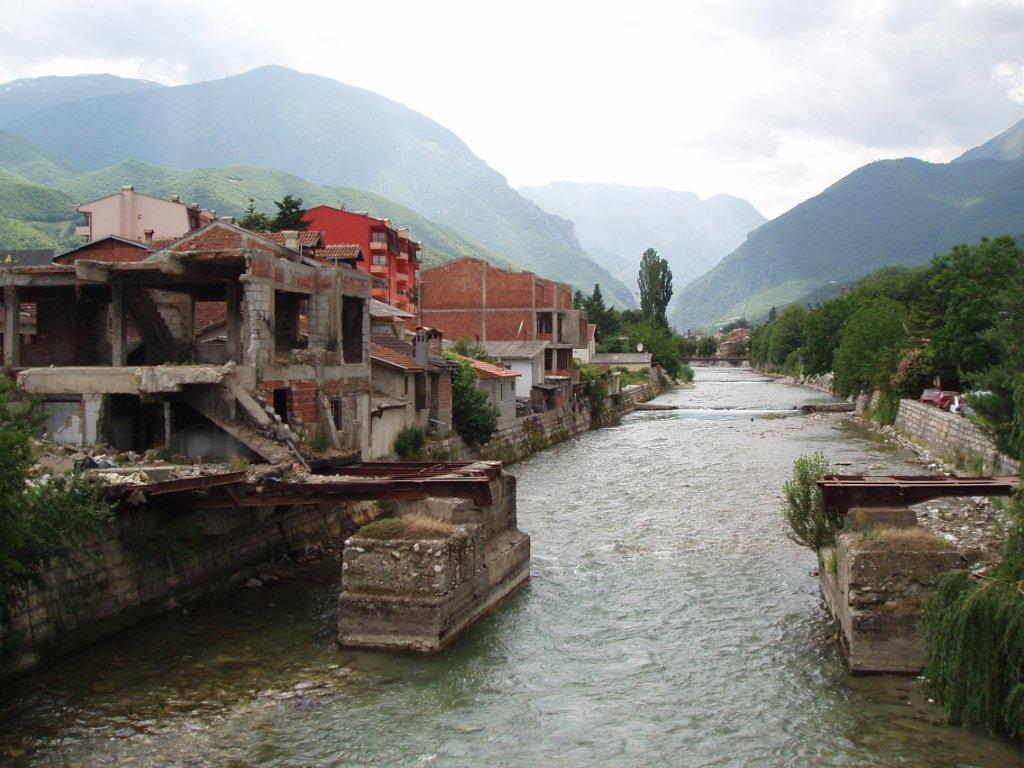
Pejë in Kosovo
Paperback coming to Amazon MARCH 14
Ebook available for preorder NOW
Learn more about SPINNING WOOL